Magdalene laundries’ confinement and forced-labour regime
Small Things Like TheseThe Magdalene laundries’ confinement and forced-labour regime is a system of institutional control that the novel first approaches through rumor, public respectability, and a community’s reluctance to interfere, then places against a historical record of incarceration, forced work, and lost children. Its significance lies in the contrast between the immaculate linen welcomed by customers and the hidden human cost borne by the girls and women inside.
Public Respectability and the Laundry
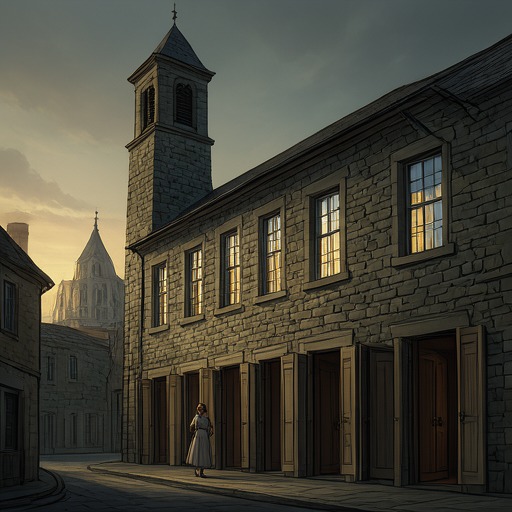
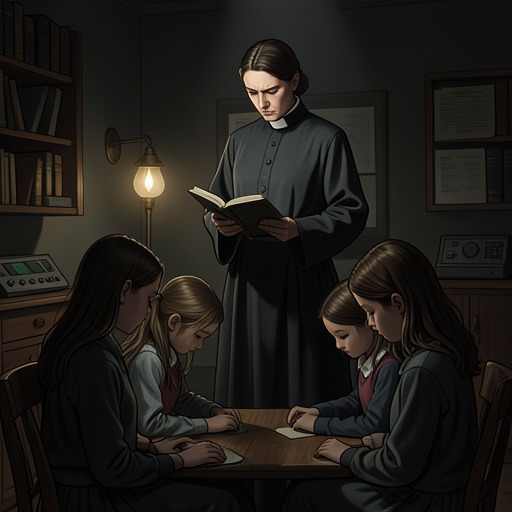
In the town, the Good Shepherd Sisters run a training school for girls, said to provide a basic education, alongside a laundry business with an exceptionally strong reputation. Restaurants, guesthouses, the nursing home, the hospital, priests, and affluent households send washing there; whether a delivery is a raft of bedlinen or a dozen handkerchiefs, it comes back looking new. The laundry’s visible service to the community makes the convent economically useful and socially respectable, even as little is known about the school itself.
That gap in knowledge is filled by competing accounts. Some townspeople say the girls are not students but young women sent there to be reformed, made to do penance by washing stains from dirty linen, and worked from dawn until night. A local nurse reportedly treated a fifteen-year-old for varicose veins caused by standing too long at the wash-tubs. Other accounts shift the burden of labor onto the nuns, describing them as overworked, poorly fed, and restricted to prayer and silence while they knit Aran jumpers or thread rosary beads for export. The rumors do not offer one settled picture of who performs the work; their very inconsistency shows how little the town can confirm about life inside.
Confinement, Labor, and Separation
The most consequential account identifies the convent with a mother-and-baby home: unmarried girls, it is said, are hidden there after giving birth, while their children are adopted by wealthy Americans or sent to Australia. The story further alleges that the nuns receive money for placing babies abroad. These claims are presented as local talk, not as verified knowledge available to the townspeople; the novel makes the distinction between hearsay and certainty part of the institution’s concealment. Yet the back matter establishes the wider historical reality: girls and women were concealed, incarcerated, and forced to labour in Magdalene laundries, while many lost their babies and the lives they might otherwise have had.
The plot gives infant separation a specific, immediate voice when a girl asks Bill Furlong to inquire about her baby. She says the child is fourteen weeks old, has been taken from her, and may be hungry; she does not know where he is. Her plea makes the laundry’s broader system legible not as abstract controversy but as a mother’s uncertainty about who is feeding her child and whether she will be allowed to do so again. The institution’s power reaches beyond the laundry floor, shaping the mother’s access to her infant and even her ability to know where he is.
Community Complicity and Individual Response
The town’s dependence on the convent helps explain why uncertainty does not become action. Eileen Furlong argues that the girls’ situation has nothing to do with their family, that the nuns need a fire like everyone else, and that they pay their bills promptly. She tells Bill that getting on in life requires ignoring some things. Her reasoning joins economic convenience to social distance: reliable payment and a useful service become reasons to leave troubling questions unanswered. She also suggests that Bill was raised far from hardship, exposing how unequal access to security shapes what each person can afford to notice or disregard.
Bill’s encounter with a girl sitting dazed at a table, with nothing before her, breaks through that habit of looking away. Though the convent expects him to leave, he pauses beside her and offers help; her response is to look toward the window, take a breath, and cry. The moment does not undo the system, but it turns the question of responsibility into a practical choice rather than a debate about rumor. Later, walking alongside her, Bill asks himself whether a person can call himself a Christian while never finding the courage to oppose what is already in place. The narrative thus measures religious and communal values against whether anyone responds to a vulnerable person’s need.
Historical Record and Aftermath
The note on the text anchors the fictional encounter in institutional history. Ireland’s last Magdalen laundry closed in 1996, but the number of girls and women confined and forced to work remains unknown. Ten thousand is described as a modest estimate, while thirty thousand is considered more likely. Many records were destroyed, lost, or made inaccessible, and the women’s labor was rarely recognized. Some lost their lives; others lost the futures they could have had. These gaps in the archive echo the secrecy and uncertainty that surround the convent in the story.
The note also records the scale of infant deaths and adoptions associated with mother-and-baby homes. The Mother and Baby Home Commission Report found that nine thousand children died in eighteen institutions it investigated. In 2014, Catherine Corless publicized her discovery that 796 babies died between 1925 and 1961 in the Tuam home, in County Galway. The note states that the institutions were run and financed by the Catholic Church in concert with the Irish State, and that the Irish government did not apologize for the Magdalene laundries until 2013. Against the Proclamation’s promise of equal rights and of cherishing all the nation’s children equally, this history exposes the distance between public ideals and institutional practice. The regime’s legacy is therefore not only forced labor and separation, but also damaged records, belated acknowledgment, and a social silence that made individual acts of care morally urgent.